








What can we learn from archaeology? Archaeology classes teach us about the past through once buried or hidden trace physical evidence. This evidence may have lain beneath the ground or been hidden in jungle foliage for centuries. Archaeology classes explain how early humans survived, what kind of technology was available to humans during prehistoric and historic periods, what humans ate, what religious traditions humans followed, and what humans valued.
Archaeology can reconstruct a lost culture's lifeways, giving us a glimpse into the long-ago past and help us understand the people and events that shaped the historical period (after the development of writing). Archaeology, it could be argued, is a kind of passport to time-travel. Students may choose courses that are more general or may choose a concentration that allows them to focus on a specific historical period or geographical location, such as Mediterranean archaeology or prehistoric archaeology.
Description of an Archaeologist
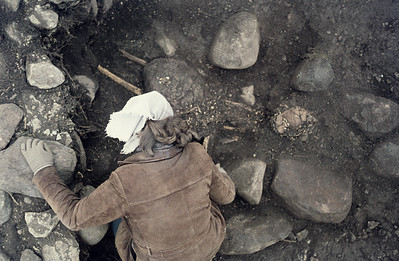 |
An archaeologist is someone who studies peoples and civilizations from the past. Archaeologists seek to understand human prehistory and history from the dawn of mankind to the near present. They document the technologies and artifacts and architectural features left behind by people and use this information to reconstruct what people were like at a given point in world history. Archaeological duties include:
- Surveying a site and laying the groundwork for excavation
- Excavating a site with spades, trowels, brushes, and other tools of the trade
- Documenting artifacts and architectural features, including taking photographs and drawings of this evidence in the context they are discovered in
- Lab work in which the more portable items can be studied in more detail
- Research on the site and the artifacts recovered
- Cleaning, bagging, and labeling discoveries for further study and preservation
Most archaeologists have at least a master's degree and many have doctorates in their field of study.
Archaeology Courses Overview
Archaeology courses vary depending on the archaeological specialization. Archaeology is a social science that can be a stand-alone discipline or fall under the umbrella of an anthropology department, natural science department, history department, and other related subjects. Some archaeological classes will be common across specializations while others are more tailored to a specific archaeological niche.
Here is a list of common subjects taught in archaeology classes:
- Surveying techniques
- Excavation methods
- Dating techniques
- Interpretation of historic artifacts
- Art history
- Ancient technology
- Historic preservation
Additionally, archaeology programs of all levels normally require field experience at a location within the United States or abroad.
 |
A List of Archaeology Courses
Some archaeology classes have broad application and are necessary to take if you intend to become an archaeologist, regardless of your specialization. Examples of topics that are covered in archaeological classes include the following.
Basic or General Archaeology Classes
Principles of Archaeology
This is a platform course for students who wish to major in history, art, archaeology, or anthropology. It explores how objects can be uncovered and studied to help scientists and scholars reconstruct societies, cultures, ceremonies, and historical peoples and civilizations. Students study the methods and tools used by archaeologists to discover and unearth archaeological features (buildings, monuments, and other immovable structures) and artifacts (portable objects, such as beads, pottery, and weapons).
Field Research
This course may be taken in a classroom, where professors review methods of dating and excavation, as well as a practicum in the field. Courses in field research are often taken at the beginning of an archaeology program and before students are allowed to do fieldwork. Stratigraphy, carbon dating, and cross-dating are a few of the methods used by archaeologists working on site. In addition to these procedures, students learn about site surveys, analysis, recording, and excavation methods. Preservation of artifacts and the funding of private and public excavations may also be covered.
Archaeological Classes: Specialization
There are a wide variety of archaeological classes to choose from, depending on your interests. Archaeological subjects and/or specializations include the following.
| Class | Description |
|---|---|
| African Studies | African Studies is the study of African societies throughout the continent of Africa from their earliest of hunter-gatherers to the rise of complex societies and kingdoms. African studies look at such factors as cultural, linguistic, economic, genes, and other variables that have interacted in the development of African peoples. |
| Paleoanthropology | Paleoanthropology is the study of human origins and evolution, and students typically take this course near the beginning of an archaeology or anthropology program. Through fossil- and artifact-based evidence, as well as the context of culture and history, students construct their own ideas about how society's views on evolution have changed. |
| Zooarchaeology | Zooarchaeology is the study of the bones and shells of ancient animals. By studying the remains, students learn how to identify the evolution and roles of animals, such as how they were used as food, tools, ritual sacrifices, and transportation. Students learn how to determine the role of an animal by studying its vertebrae and identifying slaughter methods. |
| Ancient Egypt | As a specialized archaeology course, the study of Ancient Egypt focuses on the period between 6000 B.C. and the Roman occupation. Students learn about Egypt's gods and goddesses, rulers, architecture, medicine, and the economy. By studying the artifacts found in national and international museums, students can actively piece the culture together. Students may also study hieroglyphics, the Giza pyramids, and the tombs in the Valley of the Kings, the latter of which produced one of the greatest archaeological finds in history, the tomb of Tutankhamun. |
| Classical Archaeology | Students can enroll in this class after they have completed their introductory coursework. They study ancient Greece and Rome and the material culture found in these city-states. Key works of literature and letters are studied in comparison to the political and social events of the period. Philosophy, laws, architecture, warfare, and rituals are also covered, and students acquire a better perspective of the social traditions, celebrations, and problems of the classical world and its influence on contemporary culture. |
| Forensic Archaeology | Forensic archaeology is used in the criminal justice field. Forensic archaeology is the adoption of archaeological excavation techniques into a criminal investigation. This includes using these techniques to uncover and document human remains and artifacts that may be associated with the remains. |
| Biblical Archaeology | Biblical archaeology is the study of the people and the civilizations that have fallen and risen in the Holy Lands, or the lands the Bible discusses. Students learn about the different cultures that lived and interacted with one another in the region and evaluate archaeological discoveries against biblical sources. |
| Prehistorical Archaeology | The study of cultures and civilization before the invention of writing. This includes early hunter-gatherers and nomadic peoples as well as some of the earliest cultures to transition to permanent settlements. |
| Historical Archaeology | The study of cultures and civilization after the invention of writing. These are typically societies that transitioned from hunter-gatherer lifestyles to permanent settlements and have had the time to develop a more complex, stratified society that includes writing and reading, organized religions and governments, as well as arts and crafts. |
| Introductory Cultural Anthropology | An introductory class in cultural anthropology will teach you about the variety of living human cultures and how they are socially constructed, including their norms and values, and how they adapt to and modify the environments they inhabit. |